Designing the MVP: Building the Foundation for Regal.ia’s Smart Real Estate Platform
Critical Conversations: Regal.ia x Imali Series
Starting Small to Think Big
Before touching ground in Kigali, the Regal.ia x Imali partnership began with a series of deep design conversations. The question wasn’t what to build — it was how to build something that works for everyone.
We were both thinking about the same problem from different perspectives. In Rwanda, land is abundant, but capital and coordination are scarce. In the U.S., there’s capital and technology, but access to land and equity remain barriers. So the mission was to create a Minimum Viable Product (MVP) that could bridge both realities — a digital system that connects landowners, investors, developers, and buyers through shared data and smart contracts.
“If we can gather the people who have land and show that they’re committed,” Ramba said, “we create traction that gives us credibility. Even before money moves, data becomes our capital.”
The Vision: From Individual Parcels to Collective Power
The first insight came from a simple but powerful observation: developing seven small, separate plots costs more than developing seven together. In Rwanda, each plot of land is assigned a Unique Parcel Identifier (UPI) — a digital record that already holds key data like size, ownership, and zoning. But those parcels usually operate in isolation. Ramba proposed a solution: incentivize landowners to collaborate by clustering adjacent parcels into joint developments.
The idea was that shared design and planning could dramatically reduce costs while creating larger, more attractive investment opportunities. Imagine a notification system within the Regal.ia platform:
“Your parcel can fit five apartments. If you partner with your three neighbors, that number could triple.”
The MVP would visualize that opportunity — showing landowners, on a map, how collaboration could increase their value.
Smart Contracts and Flexible Payback Models
Once the land is committed, the next question becomes: how do you pay everyone back fairly? Ramba described four models for payment and equity. Some landowners could trade their land as equity in exchange for future apartments; others might receive a mix of cash and in-kind returns once the units are sold or rented. Investors could receive rental income through automated smart contracts, ensuring transparency and accountability.
“People here have land but no liquidity,” Ramba explained. “If we can find ways to use assets without requiring cash upfront, we make development affordable and inclusive.”
The Regal.ia MVP would encode those financial models directly into its logic — turning equity, material supply, and even labor into quantifiable value.
Designing for Context
While Ramba focused on local economics, Teonna concentrated on interface and design logic. What would the user experience look like for landowners, investors, or builders logging into Regal.ia for the first time? Drawing inspiration from global tools like TestFit, which helps architects rapidly prototype feasibility scenarios, she imagined a scenario builder that allows users to visualize projects on specific sites.
“Instead of months of feasibility work,” she said, “you could draw a site, set your parameters, and the system would instantly generate viable plans — including climate data, zoning, and ROI estimates.”
But unlike existing tools, Regal.ia’s version would integrate local data — Rwanda’s UPI system, material suppliers, and community preferences — making it truly context-aware.
Building the Ecosystem: From Data to Design
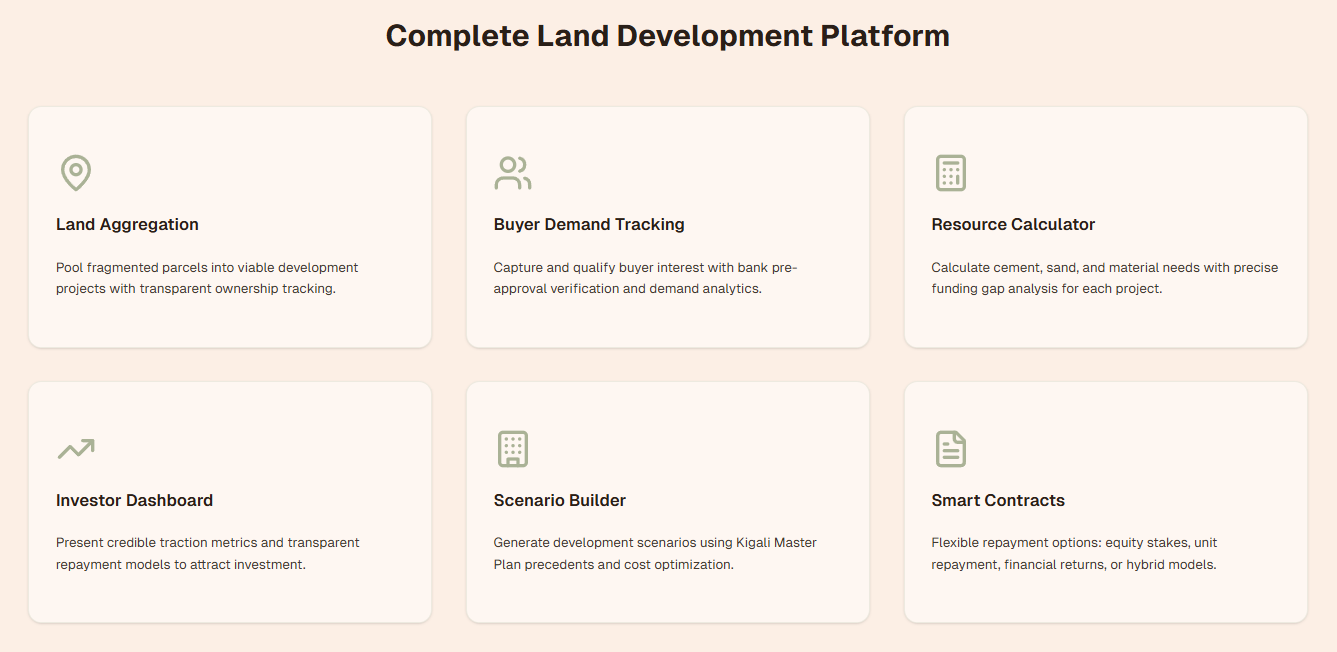
The MVP’s structure would eventually evolve into four distinct layers:
- Stakeholder Database — capturing who owns land, who builds, who invests, and who buys.
- Qualification Layer — identifying which users are verified, pre-approved, or accredited.
- Matching Engine — pairing compatible stakeholders based on shared goals, land potential, and financing needs.
- Scenario Builder — generating design and investment simulations for quick decision-making.
Each layer strengthens the one beneath it, creating a closed-loop system that turns fragmented markets into actionable networks.
“It’s not just about data entry,” Ramba emphasized. “It’s about building trust. Every new data point adds credibility — for us, for the investors, and for the system.”
Iterating Toward a Minimum Viable Future
The MVP isn’t just software; it’s a test of collaboration.
For Regal.ia and Imali, the first six months would focus on proving two things:
- That
data aggregation can attract investor confidence.
- That
local collaboration can reduce costs without sacrificing quality.
To achieve this, Ramba suggested starting with five small projects, using committed landowners and existing developments already in progress. By embedding the MVP into live projects, the system could gather data while demonstrating value in real time.
“If we can show $25 million worth of land committed through the platform,” he said, “that’s proof. Even before a single wall is built.”
Technology Meets Trust
Every conversation about code circled back to something deeper — trust. For Ramba, building in Rwanda isn’t just about technology; it’s about consistency.
“Investors start to take you seriously when they see you’re still here, still doing the work. That’s how trust grows.”
For Teonna, technology is the medium, not the message. The real value of the MVP lies in how it educates, empowers, and connects people across borders.
“Regal.ia isn’t just building a tool,” she reflected. “We’re building a shared language for development — one that makes data human and design actionable.”