
Critical Conversations: Seeding a Housing Pilot in Milwaukee
A Mecca Development Recap

Introduction: What This Conversation Was
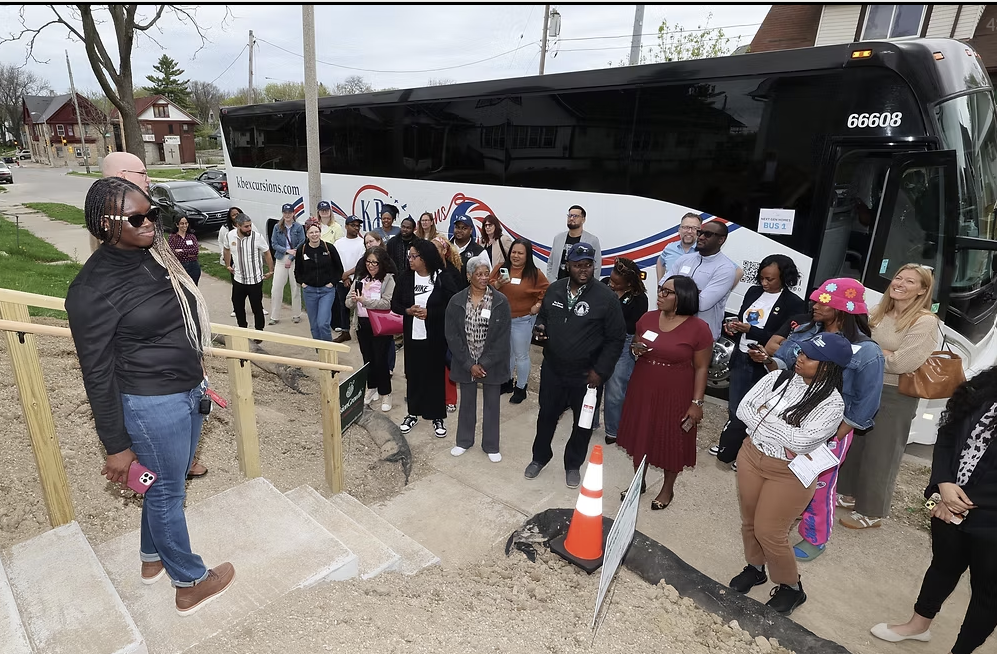
This week, Mecca Development convened the first Milwaukee session of its ongoing Critical Conversations series.
Critical Conversations is a forum designed to examine development through two perspectives that are rarely held together: the people who experience the long-term effects of development, and the people who shape decisions about land, capital, policy, and design. The intent is not consensus-building, but clarity—surfacing where perspectives diverge, where incentives misalign, and where well-intentioned systems produce unintended outcomes.
The Milwaukee series was launched with a specific aim: to seed a housing pilot. Not a comprehensive policy overhaul. Not a master plan. A pilot that can be tested, adjusted, and strengthened before ideas are locked into regulation or scaled prematurely.
This first session centered on a guiding question:
What would it actually take to launch a housing pilot in Milwaukee that is financially viable, community-centered, and adaptable over time?
Why Mecca Development Convened This Conversation
Throughout the conversation, participants returned to the same realities—described not in abstract terms, but through lived and professional experience.
They spoke about disconnects between how affordability is defined and how it is lived. About development decisions made without a full understanding of neighborhood culture. About housing projects that are designed and built, but not adequately maintained, stewarded, or adapted as conditions change. About financial models that break down before construction begins, and policies that protect communities in theory while leaving feasibility unresolved in practice.
No one named these conditions as “fragmentation” in the room. Instead, they described bottlenecks, unequal leverage among stakeholders, and gaps between intention and outcome.
Across other Critical Conversations and development contexts, these same conditions are often described as fragmentation—the separation of policy from practice, finance from lived reality, and short-term delivery from long-term impact. In Milwaukee, Mecca Development convened this session not to impose that framework, but to understand how these dynamics show up locally, through the voices of people navigating them every day.
This conversation was a first step in grounding future work—before decisions harden, capital is committed, or solutions are prematurely scaled.
What Emerged in the Room
Affordability Is Contextual, Not Fixed
Participants repeatedly surfaced the gap between affordability as defined by institutions and affordability as experienced by households. Housing that meets formal thresholds may still be unsustainable when layered onto real lives shaped by caregiving, fluctuating income, and rising costs. The conversation pushed beyond price to ask: affordable for whom, under what conditions, and for how long?
Design Without Culture Recreates Harm
Another throughline was the risk of development that is technically compliant but culturally disconnected. Participants described projects that meet zoning and financing requirements while failing to reflect neighborhood norms, histories, or daily patterns of use. Without sustained engagement, development can reproduce displacement and mistrust—even when framed as revitalization.
Housing Has a Lifecycle
Veteran practitioners reframed housing as a system rather than an event. Construction is only the beginning. Maintenance, management, financing, and adaptability determine whether housing remains an asset or becomes a liability. In historically disinvested neighborhoods, shortened housing lifecycles compound loss over time.
Naming the Economic Reality
Mecca Development shared preliminary analysis of city-owned and foreclosed properties across Milwaukee—analysis that echoed what many participants already knew from experience.
Pre-development costs alone often render projects infeasible. Zoning constraints limit viable housing typologies. Rent stabilization is essential for preventing displacement, yet without complementary incentives, it can erase already-thin margins. Together, these forces create a stalemate: land sits vacant, mission-aligned developers struggle to move forward responsibly, and community needs remain unmet.
Participants also raised a growing concern about speculation.
Milwaukee is beginning to see an influx of short-term rental and so-called “luxury Airbnb” investments, many backed by out-of-state capital. These investors are often able to withstand prolonged vacancy or underperformance—not because projects work today, but because they understand the longer arc. Milwaukee has an abundance of land. Holding costs are relatively low. And appreciation, for those who can wait, is likely.
This speculative patience deepens the stalemate. While community-centered developers face tight margins and immediate accountability, speculative actors can afford to wait—quietly shaping future outcomes before communities have the chance to intervene. Naming this dynamic was critical. Any housing pilot that ignores speculation risks addressing symptoms rather than causes.
What Is Already Working—and Who Is Holding It Together
Importantly, the conversation did not frame Milwaukee as lacking capacity.
Participants repeatedly named strong neighborhoods, committed residents, and informal systems of care that already sustain community life. Neighborhood associations, block leaders, organizers, and long-time residents were recognized for doing intentional, often unpaid work—checking on neighbors, maintaining shared spaces, advocating for safety, and filling gaps left by under-resourced public systems.
This labor is not symbolic; it is operational. It is why many blocks remain stable despite disinvestment or speculative pressure. The conversation made clear that development efforts must recognize and reinforce this existing infrastructure of care—not override it.
For Mecca Development, this reinforced a core principle: development should strengthen community capacity, not replace it.