
From Ideas to Impact: Turning Spatial Intelligence into Equity
Critical Conversations: Regal.ia x Imali Series — Designing the Future, Part 3
Seeing the System
As our September conversation stretched into its third hour, the excitement in Ramba’s voice hadn’t faded. We weren’t just sketching an app — we were outlining a framework for how data could redistribute opportunity.
“Spatial intelligence is power,” Ramba said. “But it only matters if it helps people participate.”
That became the thesis for Regal.ia’s MVP evolution. It’s not enough to digitize land, materials, and investors. The goal is to ensure that everyone — from local suppliers to first-time buyers — can see themselves in the system and benefit from it. Spatial intelligence, in this sense, becomes a tool for equity — a way to visualize and bridge the gaps between what exists and what’s possible.
Mapping Potential, Not Just Property
Traditional real estate systems map ownership, boundaries, and value. Regal.ia’s system goes deeper. It maps potential. In our discussion, Ramba emphasized that every underdeveloped parcel in Rwanda represents more than idle land — it represents an untapped network of relationships, skills, and capital.
“If a piece of land sits empty,” he said, “it’s not because there’s no interest. It’s because the system around it isn’t connected.”
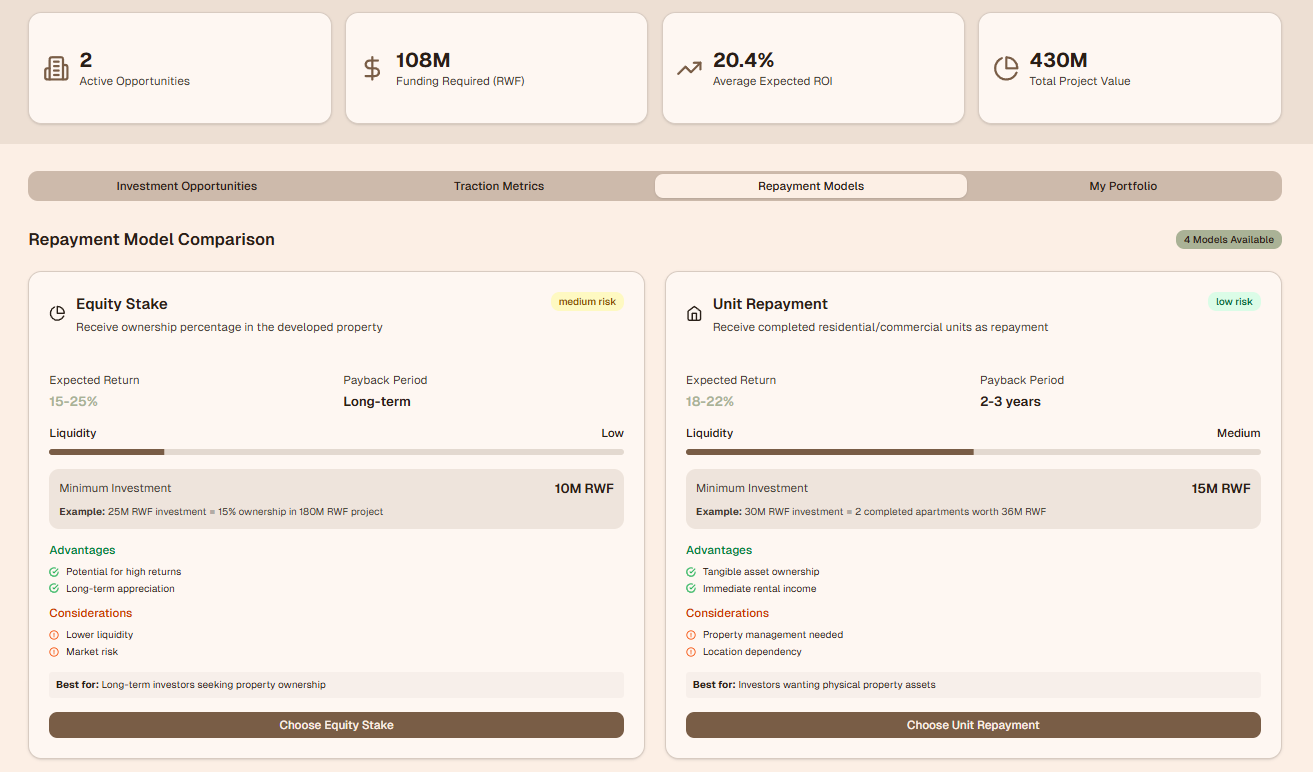
That’s what Regal.ia’s spatial intelligence layer does: it connects the dots. By combining GIS data, material supply chains, climate analysis, and financial models, the MVP doesn’t just tell you where to build — it shows you how to make it viable. It’s an ecosystem view of housing, where every decision — from roof type to financing structure — is informed by real-time intelligence.
Equity as Infrastructure
As we talked through the MVP’s social logic, one theme kept resurfacing: equity isn’t an output — it’s infrastructure.
“Equity has to be built in,” I said. “It can’t come after the profit. It has to shape how the system operates from the beginning.”
Ramba agreed. “If we can build that fairness into how the data flows,” he said, “then it becomes natural. Investors win. Builders win. Communities win.”
Regal.ia’s approach uses data transparency and participation tracking to ensure value flows proportionally. Every stakeholder — whether a supplier, builder, or fractional investor — can see their contribution reflected in the project’s lifecycle. It’s not just fairer. It’s more efficient. Transparency reduces friction, accelerates financing, and builds long-term trust across sectors that have historically struggled to collaborate.
From Maps to Markets
In the transcript, there’s a moment where Ramba outlines how mapping leads to markets:
“Once people can see the map,” he said, “they see the opportunity. A landowner becomes a partner. A supplier becomes an investor. That’s when the market starts to move.”
That shift — from ownership to participation — is the foundation of Regal.ia’s circular housing economy. When a parcel is listed, it’s not just coordinates on a map. It’s an entry point into an investment and production system that values every contribution. Landowners bring equity. Builders bring skill. Investors bring liquidity. Each role is traceable and measurable through Regal.ia’s platform, creating what Ramba called a “fair marketplace of contribution.”
Local Intelligence, Global Reach
Rwanda is the ideal testing ground for this model. Its national land registry, youth-driven workforce, and digital infrastructure create fertile conditions for a data-powered housing economy. But as we talked, it was clear that the implications go far beyond Rwanda.
“If it works here,” Ramba said, “it works anywhere. The system doesn’t depend on money — it depends on organization.”
That insight captures Regal.ia’s global vision. The platform isn’t just a Rwandan pilot — it’s a template for system replication. From Kigali to Nairobi to Detroit, the principles are the same: transparency, data interoperability, and equity by design.
Each new context adds its own layers — cultural, environmental, economic — enriching the model’s intelligence.
From Spatial Intelligence to Social Infrastructure
The true innovation of the MVP lies in how it merges spatial logic with social reasoning.
“Data without people is just numbers,” I said. “Spatial intelligence only matters when it translates into shared opportunity.”
Through the MVP’s geospatial interface, users can visualize not only buildings and boundaries but also flows of value — who contributes materials, who benefits from returns, how jobs circulate through local economies. It’s a living map of participation — one that transforms visibility into voice.
“When people can see themselves in the data,” Ramba said, “they start to believe in the system. And that belief is what makes it work.”
That’s the heart of this partnership: designing systems that people can trust enough to use, and use enough to sustain.
Impact by Design
Toward the end of our talk, I asked Ramba what success would look like in five years. He paused before answering:
“If people can build together, live together, and keep growing together — that’s success.”
That answer wasn’t about metrics. It was about
continuity. The MVP, once fully deployed, will serve as a blueprint for sustainable collaboration — a digital ecosystem that keeps learning, connecting, and redistributing value long after its creators step back. That’s what it means to move from ideas to impact: designing systems that outlive the moment, grounded in intelligence and built on equity.