From Vacant Lot to Viable Project: What We Learned During Wisconsin Tech Month
Mecca Development Presents Climate Lens during WI Tech Month
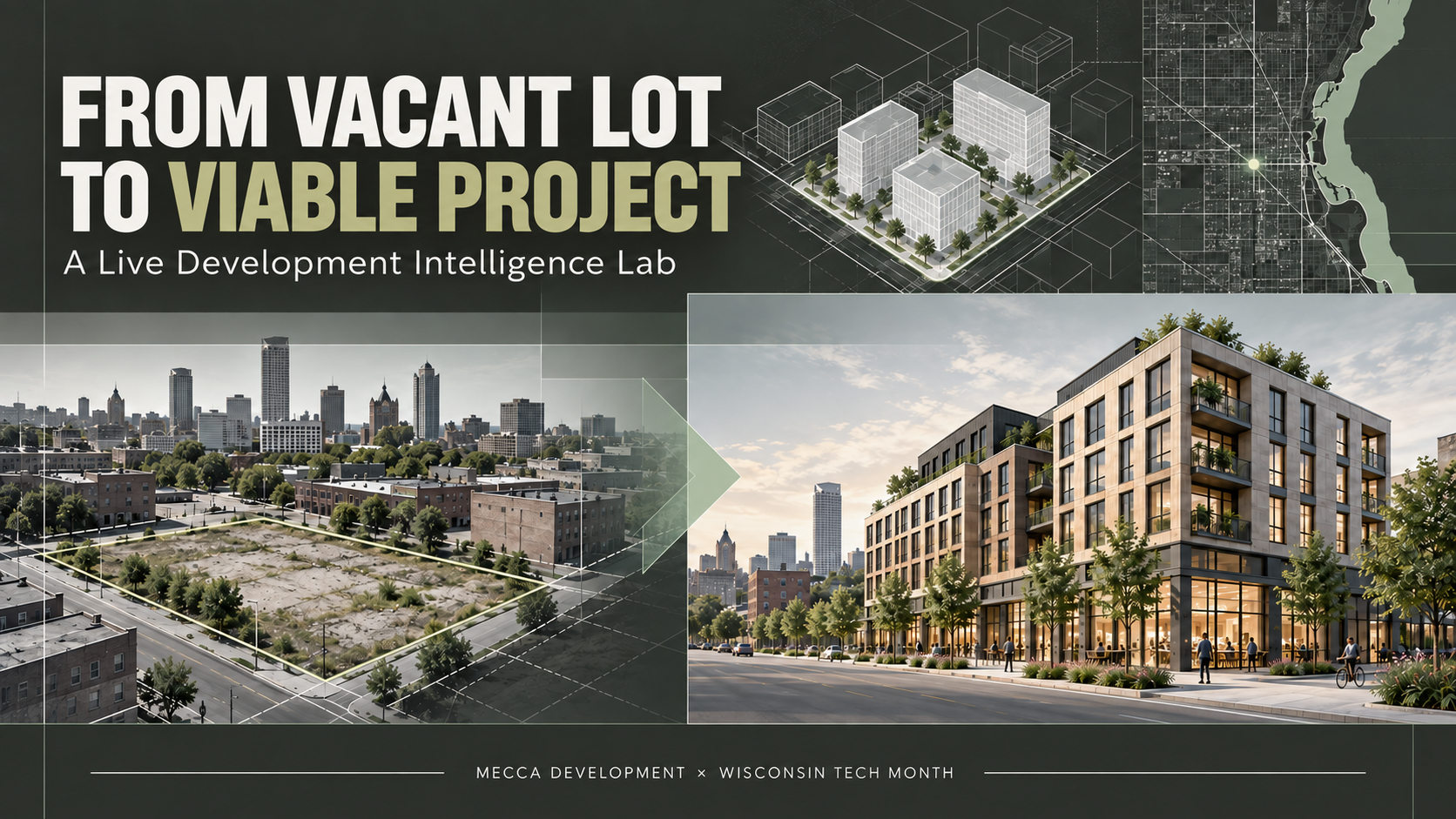
A vacant property may appear to represent a straightforward opportunity. The land is available, the neighborhood needs investment and housing demand exists. But moving that property toward development requires a much more complicated series of decisions.
What can legally be built? What does the market support? What can residents afford? Which public incentives apply? What climate and building-performance risks must be addressed? Who benefits from the investment—and who could be harmed by it?
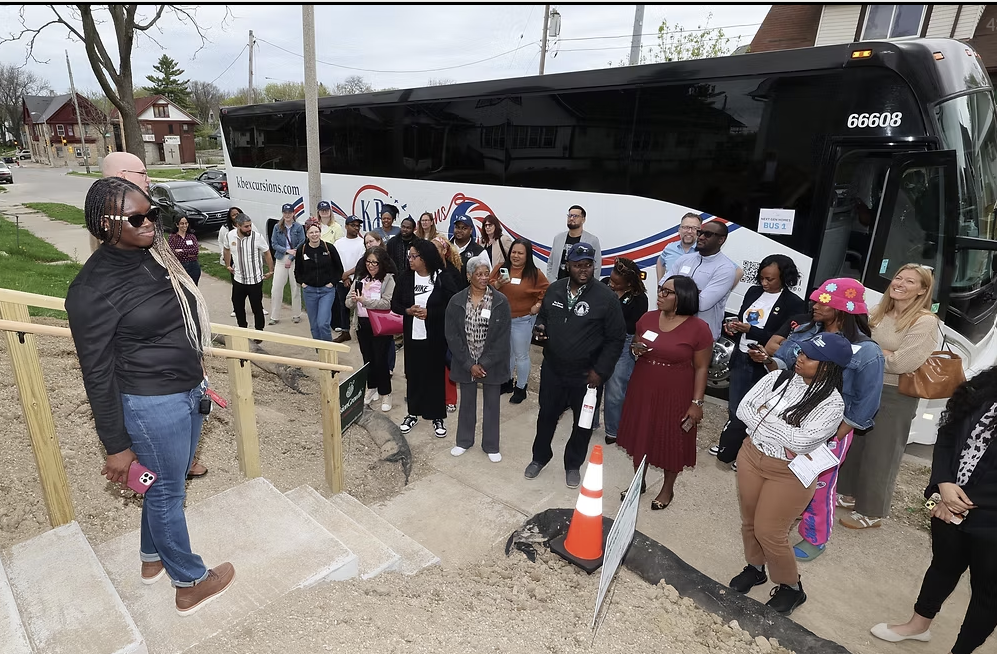
During Wisconsin Tech Month, Mecca Development hosted From Vacant Lot to Viable Project: A Live Development Intelligence Lab to explore how technology can help teams answer these questions earlier and more clearly.
Testing Climate Lens through a live Milwaukee project
The session introduced participants to the Milwaukee Housing Pilot, an initiative designed to identify viable infill and adaptive-reuse opportunities and move selected sites from analysis toward site control, financing and implementation.
We also demonstrated Climate Lens, Mecca Development’s emerging development-intelligence platform. Climate Lens is being designed to bring together information that is normally scattered across reports, maps, government databases, community plans and consultant analyses.
The platform examines factors such as:
- Neighborhood and demographic conditions
- Market feasibility
- Zoning and land use
- Public policy and incentives
- Climate risk
- Building adaptability and performance
- Community benefit
- Development risks and tradeoffs
The goal is not to allow technology to make development decisions on its own. The goal is to give architects, developers, policymakers and community stakeholders a clearer foundation for making those decisions together.
The conversation revealed the real challenge
Participants did not limit their questions to how the technology works. They asked what happens after the analysis.
One discussion focused on Lindsay Heights and the tension between neighborhood investment and displacement. Improvements can increase property values, but rising assessments may also burden longtime homeowners—particularly those living on fixed incomes. That means a development tool cannot evaluate a project solely through construction costs or potential financial return. It must also help teams consider long-term neighborhood effects.
Participants also asked whether development could support community wealth building, local businesses, employment and the services that make a neighborhood desirable and livable. These questions reinforce a principle that continues to shape Mecca Development’s work: affordable housing without pathways for residents to increase income and ownership will continually reproduce the need for more affordable housing.
Another participant observed that Climate Lens could simplify information that is usually difficult for nonprofessionals to access. Traditional engagement processes often ask residents what they want, after which technical teams leave the room to interpret those ideas. A more transparent tool could allow community stakeholders to see how priorities become development assumptions, strategies and tradeoffs.
What we learned about the product
The session produced several clear directions for Climate Lens.
First, every demonstration should begin with a clearly defined project problem. Rather than introducing the platform in isolation, future sessions will frame a site, its constraints and the decision the project team must make. Participants can then follow how the tool supports that decision.
Second, the tool must remain transparent. Users should be able to understand where information came from, what must still be verified and how recommendations were generated. This is especially important as machine learning and artificial intelligence become more integrated into development analysis.
Third, different users require different pathways. Architects may prioritize building performance and design responses. Developers may focus on feasibility, capital and risk. Policymakers may need to understand incentives and community outcomes. Residents may need a clearer way to see how a project could affect affordability, services and neighborhood stability.
Climate Lens must connect these perspectives without pretending that they are identical.
Moving from demonstration to implementation
Climate Lens is still an emerging platform. The next stage is to test it through live projects, document how it influences real decisions and improve the underlying data and methodology.
Mecca Development is looking for organizations and individuals interested in:
- Piloting Climate Lens on a live or upcoming site
- Co-developing datasets, indicators or technical capabilities
- Hiring Mecca Development to support development strategy
- Sponsoring research and software development
- Joining the early-access waitlist
The Wisconsin Tech Month session was an opportunity to present what we have built. More importantly, it allowed us to listen—to the questions, concerns and possibilities that should shape what comes next.
Transforming a vacant lot into a viable project is not only a design problem, a financial problem or a technology problem. It is a coordination problem.
Our work is to connect the information, people and decisions required to move from possibility toward implementation.
Interested in piloting Climate Lens or contributing to its development? Connect with Mecca Development at [LINK].